
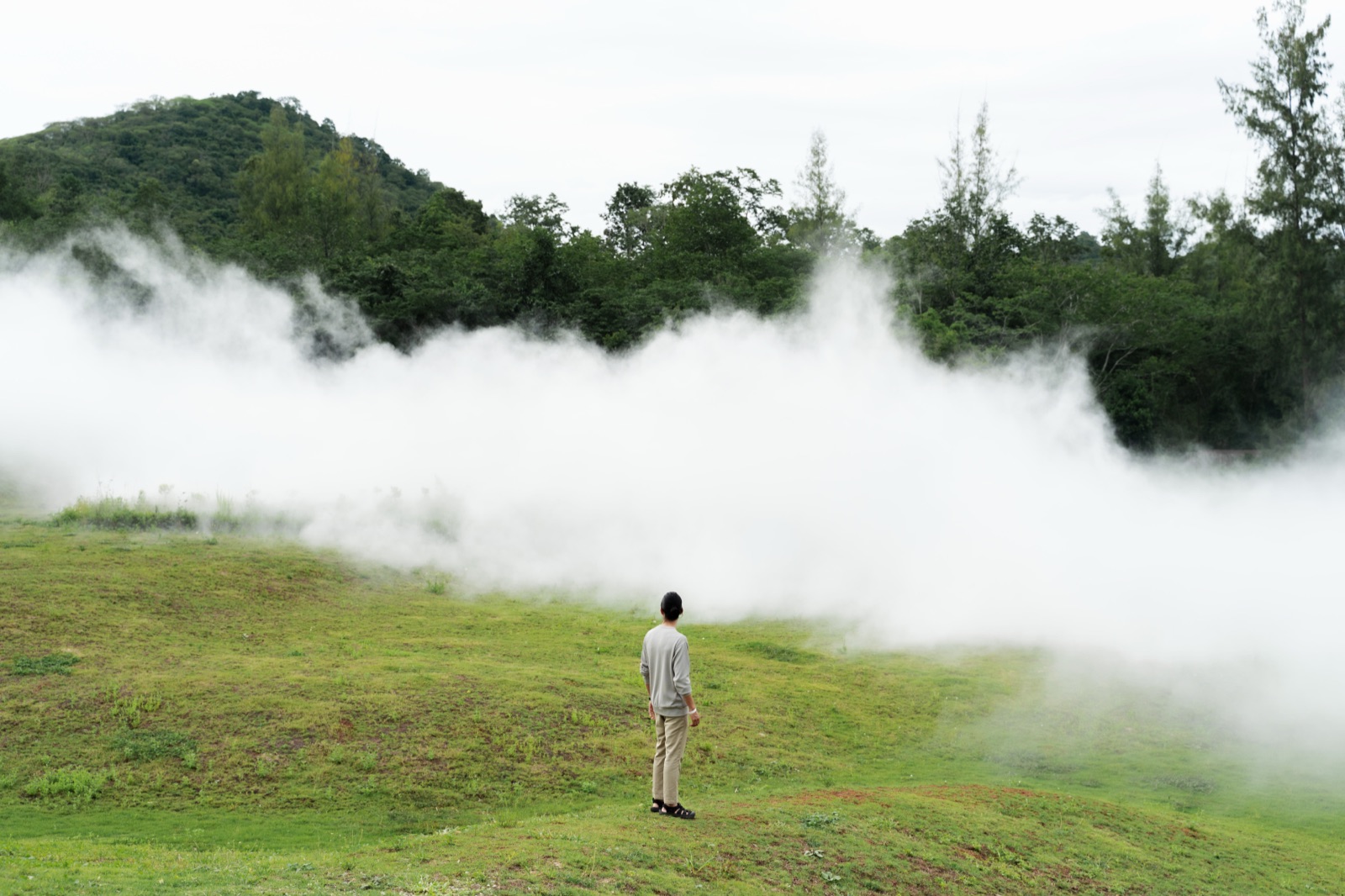
If you live in Bangkok, "getting into nature" probably sounds like a project: a long weekend, a drive upcountry, a resort booking. So it gets postponed until the next holiday, which is usually months away. A new study from the University of Hong Kong offers a far more useful answer to the question of how much time in nature per week actually matters. The short version: the first hour does a surprising amount of the work, and after that the returns flatten quickly.
That changes the advice for busy professionals. The goal isn't one big escape a year. It's a small, regular dose you can protect in your calendar.
What the new "dose of nature" research found
In November 2026, researchers at the University of Hong Kong published a meta-analysis in the Journal of Environmental Psychology that pooled observational studies published between 1980 and 2025 on weekly green-space exposure and mental health outcomes: stress, anxiety, depression and mood. Rather than asking whether nature helps, they asked how much is enough, and modelled the shape of the curve.
According to the university's release, the benefit rises steeply at low doses and then levels off:
- About one visit, or one hour a week, was linked to roughly 50% of the maximum estimated benefit.
- About four visits, or four hours a week, reached roughly 90%.
- About six visits, or eight hours a week, reached roughly 99%.
Two details matter for how you read those numbers. First, the percentages describe a share of the model's maximum estimated benefit. They are not a 50% drop in stress or anxiety, and nobody should quote them that way. Second, the hours are cumulative across the week, not the length of a single outing, so two half-hour walks count the same as one hour.
As co-author Professor Gunter Schumann put it, "the steepest gains occur at low doses; one hour or one visit per week already achieves half of the modelled maximum response."
The insight most people miss: frequency beats the big escape
Here's the counter-intuitive part. Because the curve flattens, moving from zero to one hour a week is worth far more than moving from four hours to eight. For a city professional, the most valuable unit of nature isn't the annual mountain trip. It's the next seven days.
Think of it like sleep or exercise. A single long weekend can feel wonderful, but it can't do the job of a weekly habit. If your natural time arrives in one block every few months, you spend most of the year at the bottom of the curve, which is exactly where each hour counts most.
That's also why we don't think of nature as a luxury add-on. For people who spend their days between air-conditioned offices, cars and screens, a short, regular dose is one of the more realistic changes available, and it costs very little.

Slowing down among the trees at a Healiday event in Khao Yai.
What the evidence does and doesn't show
We like this study because it's practical, but it has clear limits, and the authors say so:
- It's observational. It synthesises studies that observe people's habits and wellbeing. It doesn't prove that one hour of nature causes a specific change.
- It describes populations, not individuals. The authors note the benchmarks are broad relationships across studies and don't guarantee the same outcome for every person. They also stress that the benchmarks complement, rather than replace, clinical treatment.
- The numbers are rounded reference points from separate models. The "visits" figures and the "hours" figures shouldn't be combined into one rigid schedule.
- The type and quality of green space weren't settled. The researchers call for more work on how quality, activity and personal circumstances shape results.
The first author, Dr Jiali Li, offers refreshingly modest advice: start with a routine you can sustain, such as a weekly park walk, and treat the benchmarks as "an achievable starting point, rather than a fixed prescription for everyone." No commercial interest is stated in the university's release.
How to build your weekly nature dose in Bangkok
You don't need a forest on your doorstep. You need a plan that survives a busy week.
1. Book the first hour like a meeting
Pick a fixed slot, such as Saturday morning or a weekday before work, and put it in your calendar. The first hour is where the curve is steepest, so protect it before anything else.
2. Split it if you have to
Because the research looked at weekly totals, two 30-minute walks count. A lunchtime loop of a city park and a slow early-evening walk on another day get you there.
3. Make it actual green space, and actually be there
Choose places with trees and vegetation rather than a covered walkway. Leave the podcast off for at least part of the time and notice what's around you. You're there to be outside, not to clear your inbox on foot.
4. Plan one deeper dose a month
Once the weekly hour is a habit, add a longer, slower session somewhere greener. Bang Krachao, the green "lung" on the bend of the Chao Phraya, is about 30 minutes from central Bangkok and makes a realistic half-day option.
5. For leaders and HR: make it a team habit
If you manage people, the same logic applies to your team. A one-off offsite in the hills won't move the curve for the other 51 weeks of the year. Encouraging walking one-to-ones, outdoor lunch breaks or a quarterly nature half-day builds the regular dose into the working week instead.

An outdoor stretch between sessions at a Healiday event in Khao Yai.
Where Healiday fits
We designed our Forest Bathing session as an easy "deeper dose" for people who can't take days away. It's a guided, three-hour session at Bang Krachao in a private space, about 30 minutes from Bangkok, combining a slow, mindful forest walk with sound and traditional Thai herbal elements. It's designed for groups of 10 or more.
For individuals who want a fuller reset with health screening, our private three-day, two-night Restore Retreat in Bangkok includes an in-depth health screening at a licensed partner facility, restorative sessions, a private expert session designed with physician input, and a personal report with a 90-day lifestyle plan, which is a natural place to build a weekly nature habit into your routine. Some Restore sessions, such as hyperbaric oxygen sessions, the ice bath and the sauna, aren't suitable for everyone, including people with heart conditions or high blood pressure, or during pregnancy, so every guest is screened first.
Frequently asked questions
How much time in nature per week do you need?
A University of Hong Kong meta-analysis (2026) found that about one hour or one visit a week was linked to roughly half of the maximum estimated mental-health benefit, about four hours to roughly 90%, and about eight hours to roughly 99%. These are population averages from observational studies, not a personal prescription.
Does the hour have to be in one go?
No. The researchers looked at cumulative time across the week, so shorter visits that add up to an hour count.
Does a city park count as nature?
The research looked at green-space exposure generally, and the authors suggest a weekly park walk as a sustainable starting point. Leafier, quieter spaces are a good choice when you can reach them.
Is forest bathing the same as hiking?
No. Forest bathing is slow and sensory rather than a workout. A guided session focuses on walking gently, noticing your surroundings and resting, which makes it accessible for most fitness levels.
Start your weekly dose
One hour a week is a small enough goal to start this week. If you'd like a guided deeper dose for your team, enquire about Forest Bathing at Bang Krachao, or take the assessment to find the right reset for you. Make your holiday a Healiday.
Sources
- EurekAlert / The University of Hong Kong – "HKU study establishes weekly 'dose-of-nature' benchmarks for mental health benefits" (16 Nov 2026)
- Li J, Gong P, Schumann G, Webster C, Jiang B. "A generalized relationship between dose of greenspace exposure behaviours and mental health responses." Journal of Environmental Psychology 115, 103211 (2026)
- Healiday – Group programs (Forest Bathing)
- Healiday – Restore Retreat
This article is for general information and is not medical advice. Healiday retreats are wellness programs and do not diagnose, treat or cure any medical condition. Health screenings and therapies are provided by licensed partner facilities, subject to medical suitability, and individual experiences vary.